MCS AI Mission Statement | How the Use of AI Supports Student Learning | Ongoing Evaluation | Frequently Asked Questions | Next Steps
MCS AI Mission Statement

Artificial Intelligence (AI) is becoming a regular part of everyday life, from the apps we use to the tools students will encounter in college and careers. At Middleburgh Central School District, we believe it is important to teach students how to use these tools in ways that support learning, encourage creativity, and protect academic integrity.
The Middleburgh Board of Education Policy 5840 outlines how AI may be used in our schools. The goal is simple: we want students to learn how to use AI responsibly, ethically, and effectively. AI should enhance student thinking — not replace it. We are committed to balancing innovation with our core values of honesty, equity, privacy, and high academic standards.
See the complete MCS board policy on BoardDocs.
How the Use of AI Supports Student Learning
In The Classroom
Instructional staff has and will continue to receive support in integrating AI into teaching and learning in ways that enhance student engagement, uphold academic integrity, and align with the district’s developmental framework for student use.

Here are some examples of ways faculty might use AI to enhance student learning:
- Developing new approaches:
“Help me brainstorm real-world applications to teach the Pythagorean geometry theorem,” or “Suggest 3 creative ways to introduce a new topic so students are curious and engaged.” - Developing new visual aids:
“Generate infographics that are customized to support three different visual learning styles.“ - Streamlining a task:
“Suggest a system to make it easier to organize classroom supplies.” - Professional development:
“Create an audio version of this article so I can listen to it during my prep time.” - Maximizing collaboration:
“Write simple, step-by-step directions for my classroom activity so that a substitute teacher could run it easily.”
This example shows targeted personalization to help keep students engaged. This study habit poster was AI-prompted to use Greek mythology to build on a student’s interests.
Student Use of AI
MCS has created a developmental framework that builds skills and responsibility over time. The district’s intent is to help all students develop the literacy, curiosity, critical thinking, and ethical reasoning necessary to use AI as a support for — not a substitute for — learning.
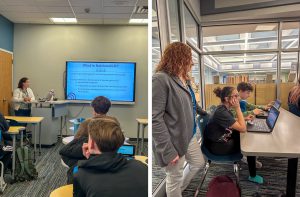
- Students in PK–2 will not directly interact with open-ended or generative AI tools. Teacher supervision is required at all times. Instructional focus will emphasize early literacy and exploration.
- Students in grades 3-6 may use AI tools during instruction and under teacher direction. Instructional focus will be on writing clear, effective prompts and identifying bias, inaccuracies and limitations in AI outputs. Digital citizenship skills are reinforced continually.
- Students in grades 7-12 may use approved generative AI tools aligned with coursework, electives, and college/career pathways. Teachers provide oversight while students demonstrate increasing self-regulation. Instructional focus will be on deepening AI literacy and ethics and real-world applications. Students will use AI transparently and ethically, including providing proper citation. They will develop and maintain a personal AI Ethics Statement.
For more details about instructional focus, student outcomes and safeguards, view the complete developmental framework, i.e. the Framework for Student Use of Artificial Intelligence.
All students must only use district-approved AI platforms that meet all Family Educational Rights and Privacy Act (FERPA) and EdLaw 2-D requirements for student protection.
Use of AI at The District Level
Non-instructional and operational staff have and will continue to receive training focused on how AI can streamline workflows, improve efficiency, and strengthen the services they provide to students, families and the community.
Ongoing Evaluation
MCS has adopted these guidelines to help students and staff remain at the forefront of academic excellence and technological advancement. As new technologies and methodologies emerge, the district will continuously evaluate and reflect on the best practices to integrate AI into the learning environment.
Frequently Asked Questions
What Are The Risks And Limitations of AI? What About Ethical Considerations?
The use of AI comes with some risks and limitations which include, but are not limited to:
- AI can generate plausible, but false or inaccurate, information, a phenomenon known as a hallucination or confabulation
- AI tools learn from data created by people, which means any biases, prejudices, and stereotypes in that data can be reflected in the outputs produced by AI.
- AI may pose copyright issues as it may have used copyrighted material within its training data without explicit permission from the copyright holders.
Staff and students will be trained to spot these limitations and evaluate their impact on the use of AI tools. AI is intended to support, not replace, an employee’s responsibility for the accuracy of their own work.
How Will Student Privacy Be Protected?
The district is committed to safeguarding personally identifiable information (PII) and ensuring compliance with all applicable data privacy laws and regulations. PII includes any information that can be used to identify an individual, such as names, student ID numbers, addresses, dates of birth, contact information, demographic details, or any combination of data points that could reveal a student’s or staff member’s identity.
Users must exercise caution when entering information into any Generative AI tool. Staff may enter student or staff PII into an AI platform only if the platform has a fully executed Data Protection Agreement (DPA) on file with the district and the use of PII is permitted under the terms of that DPA.
For any AI platform without a district-approved DPA, PII must not be entered under any circumstances. Further, if the information would not be disclosed in response to a Freedom of Information Law (FOIL) request, it should not be entered.
How Can Parents and Guardians Ensure AI is Used Correctly at Home?
AI is intended to support learning, not replace it at school or at home. While we want students to harness the benefits of AI technologies, we don’t want AI to get in the way of learning. Working together, MCS, parents and guardians can ensure students are challenged in ways that will lead to growth.
This video by Common Sense Education titled “Using AI Wisely for School Success” provides a starting point for conversations about how to correctly incorporate AI usage into at-home learning.
Common Sense Media, a nonprofit organization providing age-based reviews and digital literacy resources, and Day of AI, an MIT researcher-developed curriculum and initiative designed to teach K-12 students about artificial intelligence, have published the suggested “Using AI Wisely for School Success” guide below on the use of AI for homework assistance.
Using AI Wisely for School Success:
Before – During – After AI Homework Check
Use this simple routine from Common Sense Media to guide healthy AI use.
Before Using AI
|
During AI Use
|
After AI Use
|
Why this routine helps
Research suggests students learn more when they pause to reflect on what they understand before and after using AI, not just during. Being able to explain an answer without AI is a strong sign that real learning happened.
Next Steps
As MCS continues to evaluate the use of AI, parents and guardians are encouraged to bring any ideas or concerns to the attention of the district to help guide future AI policies. They may reach out to their child’s teacher, principal or the superintendent.
You must be logged in to post a comment.