
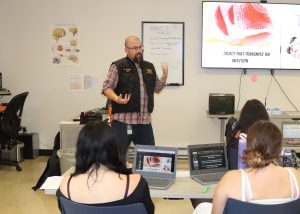
 One wants to be a neurologist, another a firefighter, but the students in the new Capital Region BOCES Emergency Medical Technician program all have one thing in common – a desire to help others.
Launched earlier this month, the one-year Career and Technical Education (CTE) program is currently preparing nearly 30 high school students, including MCS student Bianca G., for careers in emergency medicine.
 “I want to be a neurologist, so I figured this would be a good way to get a better understanding of the healthcare industry,” said Bianca, who attends the Schoharie campus program.
The one-year Emergency Medical Technician program is a hands-on program that combines classroom instruction, laboratory skill practice and real-world scenarios to develop the knowledge and competencies required for pre-hospital emergency care. Students will assess, treat and transport patients experiencing medical and traumatic emergencies while emphasizing teamwork, safety, communication and professionalism.
The program also gives students the skills and certifications they need to pursue careers as firefighters.
Capital Region BOCES launched the new program in response to requests from business and community partners.
The number of active EMS responders in New York state declined by 17.5% between 2019 and 2022, according to the NYS EMS Workforce Report, 2024. The decline jeopardizes the ability of communities to respond to emergencies effectively, especially as the demand for emergency medical care continues to rise. Additionally, nationwide, nearly 60% of EMS agencies report insufficient staffing to meet 911 call demands, leading to delayed response times and increased risks for patients in critical need, as revealed by the What Paramedics Want in 2024 report.
CTE Director Jeff Palmer said Capital Region BOCES said the program addresses a critical state and national shortage of emergency medical technicians.
“Capital Region BOCES is always ready to rise to the occasion to help with workforce development in industries that are suffering shortages of skilled workers.
There may be no more critical shortage of workers than in emergency medicine, where virtually every provider is in need of skilled workers,” Palmer said.
You must be logged in to post a comment.